
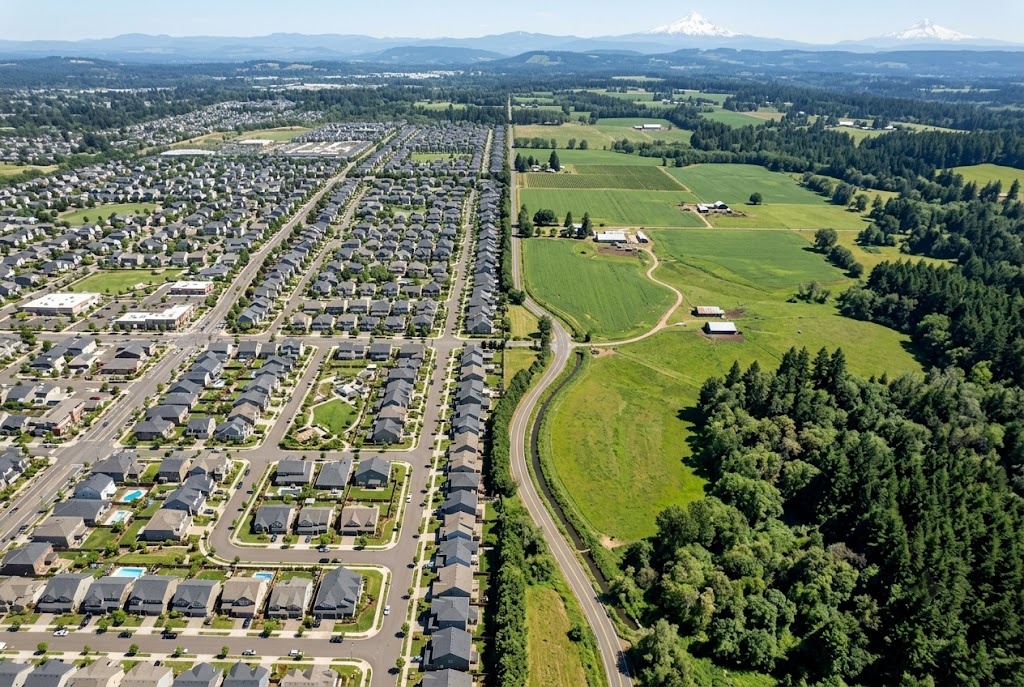
Oregon’s land-use planning system is widely considered the most comprehensive and protective statewide growth management framework in the United States. Instituted over 50 years ago under Governor Tom McCall and Senate Bill 100, Oregon’s land-use laws regulate how land is developed, preserved, and zoned across all 36 counties.
The Statutory Foundation: Senate Bill 100
Enacted in 1973, Senate Bill 100 created the Land Conservation and Development Commission (LCDC) and mandated that every incorporated city in Oregon establish an Urban Growth Boundary (UGB). A UGB is an officially defined boundary line encircling a municipality, designating land inside for urban development while zoning land outside exclusively for agriculture (Exclusive Farm Use – EFU), forestry, or open space.
Economic Effects of UGBs on Real Estate Valuation
For home buyers and property investors, Urban Growth Boundaries shape the local housing economy in several profound ways:
- Higher Land Value Within Boundaries: Restricted land supply inside the UGB inflates parcel prices, encouraging vertical density and efficient infrastructure utilization.
- Protection of Agricultural & Forest Economies: Surrounding farmland in the Willamette Valley and Hood River is permanently protected from suburban subdivision sprawl, safeguarding Oregon’s wine, timber, and agricultural sectors.
- Periodic UGB Expansion Process: Cities conduct long-range population and housing capacity studies every 6 to 10 years. UGB expansions are highly regulated and require strict state approval before farm land can be converted into residential subdivisions.
Legislative Evolution: HB 2001 and Middle Housing Density
To combat housing affordability pressures while preserving UGB boundaries, Oregon enacted House Bill 2001 in 2019. This law requires Oregon cities with populations over 10,000 to allow middle housing options in traditional single-family zones.
Oregon Zoning & Real Estate Market Outlook
Watch this expert video analysis explaining how Oregon’s land-use laws and zoning rules shape housing prices and investment trends:
Types of Middle Housing Created Under HB 2001
Property owners and developers can now build several distinct residential housing types on parcels previously restricted to single-family homes:
- Duplexes, Triplexes & Quadplexes: Multi-unit residential structures built on standard residential lots, offering excellent rental yields.
- Cottage Clusters: Groupings of small footprint single-family homes arranged around a common green space, ideal for infill community development.
- Accessory Dwelling Units (ADUs): Detached or attached secondary dwelling units on single-family properties, popular across Portland, Eugene, and Bend for rental income.
Statewide Planning Goals 1 Through 19
Oregon’s land-use framework is guided by 19 comprehensive Statewide Planning Goals. These goals mandate local government compliance across critical categories including Goal 3 (Agricultural Lands), Goal 4 (Forest Lands), Goal 7 (Areas Subject to Natural Hazards), Goal 10 (Housing Capacity), and Goal 14 (Urbanization). Understanding these planning goals gives real estate investors and developers a massive advantage when identifying parcels suitable for long-term rezoning or infill projects.
Commercial Zoning and Mixed-Use Corridor Development
Within Urban Growth Boundaries, commercial zoning designations—such as Commercial Mixed-Use (CM) and Employment Zones—encourage ground-floor retail topped by residential apartments. Developers and real estate investors utilize these zoning overlays to maximize land utilization along transit corridors, creating vibrant, walkable urban centers.
Public Hearing Processes and Land-Use Appeals
Major land-use modifications, UGB adjustments, or conditional use permits require public notifications and hearings before local planning commissions. Land-use decisions can be appealed to the Oregon Land Use Board of Appeals (LUBA), a specialized state tribunal established to ensure all municipal decisions adhere strictly to Statewide Planning Goals.
Related Guides:
- Navigating the housing market? Read our full Oregon Property & Real Estate Guide.
- Developing or investing in middle housing? See our guide to Investing in Oregon Real Estate.
Key Relocation Checklist and Expert Local Advice
To ensure a seamless transition when moving to Oregon, establish a structured timeline at least 60 to 90 days before your move date. Securing housing, transferring professional state licenses, updating automotive insurance policies, and establishing local banking relationships early eliminates last-minute stress.
Furthermore, taking time to tour local neighborhoods at different times of day helps you gauge traffic patterns, ambient noise levels, and proximity to grocery stores, medical clinics, and public parks. Connecting with local community groups, neighborhood associations, and regional online forums provides valuable first-hand recommendations from long-time residents.
Long-Term Economic Outlook and Community Integration
Oregon’s long-term economic strategy continues to prioritize sustainable growth, clean energy development, tech innovation, and agricultural export. As regional infrastructure expands to support growing populations, housing values across established suburban corridors remain supported by strong fundamental demand.
Engaging with local civic organizations, volunteering with regional environmental stewardship non-profits, supporting independent local businesses, and participating in seasonal community festivals allow new residents to quickly build meaningful personal networks and integrate into Oregon’s distinct civic culture.
Administrative Setup, Healthcare Registration, and Public Services
Once settled, complete your administrative requirements promptly. Registering your vehicle and updating your driver’s license with the Oregon DMV within 30 days of arrival is mandated by state law. Setting up patient portals with major health networks like OHSU, Providence, Legacy, or St. Charles ensures your family has immediate access to primary and emergency medical care.
Additionally, review local waste management schedules, emergency management alert systems (such as PublicAlerts in the Portland metro area or Deschutes County Emergency Alerts in Central Oregon), and regional library networks. Oregon’s public library systems offer outstanding digital media access, community workshops, and youth educational resources free to all residents.
Related Posts

Oregon Property & Real Estate Guide: Navigating Housing Markets Across Regions
Navigating the Oregon real estate market requires an understanding of…

Home Inspection Contingencies in Oregon: Radon, Sewer Scope, and Moisture
Executing a thorough property inspection is the single best way…
Buying Rural Property & Acreage in Oregon: Well, Septic, and Water Rights
Purchasing rural acreage, a farm, or a mountain homestead in…